
Everest Season Begins with Poop Bags, Huge Crowds, and New Rules
Everest Season Begins with Poop Bags, Huge Crowds, and New Rules for Tourists, mountain climbers as well as Trekkers
This week marks the official start of the 2024 climbing season on Mount Everest, with some expedition teams arriving at Base Camp and others starting their acclimatisation rotations on the summit. Due to the hazardous circumstances in the Khumbu Icefall, the formal start on the Nepali side of the mountain has been postponed this year, as reported by Outside. Because of the extremely dry winter and low snowfall, the glacier convoluted route that leads to the easier ascent to Camp I and Camp II is longer than in prior years.
There are other factors at play this year that are affecting expeditions to the highest mountain in the world besides the new route and schedule delay.
Certain climbing teams have withdrawn from the southern Base Camp in Nepal due to competition from China. Furthermore, certain teams’ approaches to safety, etiquette in Base Camp, and even poop will change as a result of new laws and regulations enforced by the Nepali government.
Along the ascent, climbers might run into a few less of their colleagues because recent remarks from Nepalese officials suggest less people than in previous years. The nation anticipates issuing 400 climbing licences for the season, down from the record-breaking 478 issued the previous year, according to Rakesh Gurung, Director of Nepal’s Department of Tourism. 34 separate expedition teams had received 365 permits as of April 22. Gurung stated that the processing of permits for three more teams is ongoing.
Gurung declared, “Climbing permits are down across all the peaks.” “China is accepting applications for Everest permits this year, which is one reason, and the other is the state of the world economy.”
How the Everest Trek Became an IndustryIn fact, China reopened its borders to Everest climbers in 2024 after a four-year closure because of the Covid pandemic. The Chinese Base Camp is much easier to get there by automobile than the Nepali Base Camp, which makes transportation there considerably simpler. Because they believe that Everest’s northeastern ridge is less susceptible to avalanches and rockfall than the southern flank, some expedition operators advise climbing from the Chinese side. Another benefit is the smaller crowds on the Chinese side.
However, there is a disadvantage to climbing from China: as of right now, the government does not even authorise climbers to enter the nation, let alone issue the final permits to Everest expeditions. Officials informed expedition operators just this week that they would be permitted to enter the nation on May 7, which is a considerable delay from the initial schedule.
The CEO of Alpenglow Expeditions, Adrian Ballinger, told Outside that “thankfully the north side doesn’t have the same end-of-season issues that the south side does.” Since Everest casts a shadow over Tibet, the monsoon typically arrives much later. Although it’s not ideal, everyone is doing their hardest, and that’s our strategy.
The Everest delay is just one of several obstacles Chinese climbers must overcome. Recently, the nation suspended all climbing on the 26,864-foot Cho and 26,335-foot Shishapangma.
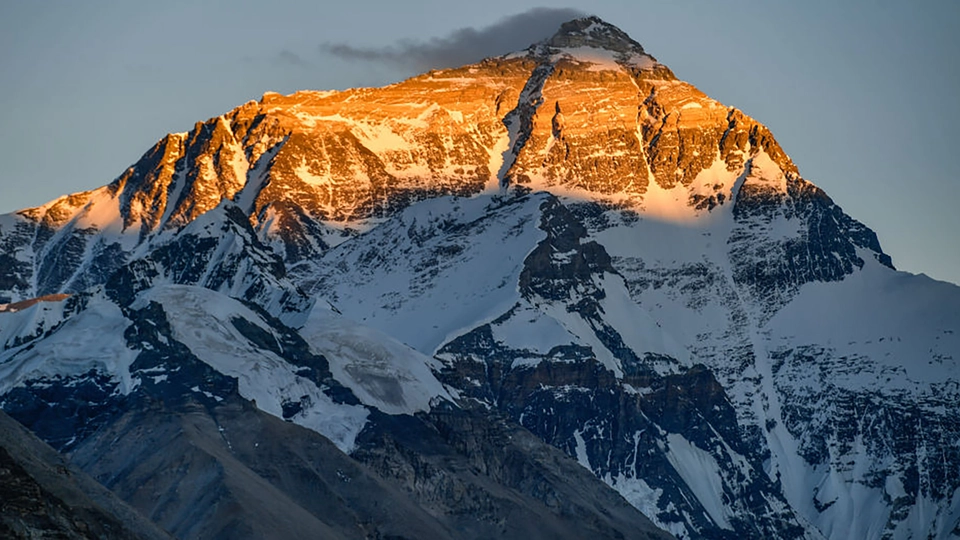
Nepal’s Everest Base Camp.
An overview of the Base Camp in Nepal. (Image: AFP/PRAKASH MATHEMA)
In 2023, a record number of people died climbing Everest, and increasing pollution at the summit forced Nepali authorities to implement new rules governing climbs. The rules cover a broad range of activities, including Base Camp tent size restrictions and climber safety. The new requirement that all climbers transport their human waste down the mountain in biodegradable bags and deposit it at a collecting centre at Base Camp may be the most onerous regulation.
This programme is run by the Khumbu Pasang Lhamu Rural Municipality, the local government organisation in charge of the Everest region.
The organization’s chief administrative officer, Jagat Prasad Bhusal, claims that officials are still discussing exactly what to do with all of that waste.
“We are presently investigating our alternatives for disposing of the waste. If possible, we will carefully dispose of it close to Tengboche or Pangboche in Upper Khumbu, or turn it into manure,” he stated.
Even though the poop restriction poses logistical issues, expedition operators who spoke with Outside expressed positive feeling towards it. The globe is moving towards sustainability, thus this will be advantageous in the long run. It is always a good idea to make a small donation to support the mountain. stated Guragai.
Climbers must wear RECCO-style tracking reflectors during their ascents, according to another new regulation. With the help of a specialised transponder that tracks the reflectors, rescuers should be able to locate lost climbers thanks to this technology. However, there are concerns that this won’t work given Everest’s high altitude and extensive terrain. “We’re not sure how well it will function,” Gurung stated to Outside. “But let’s give it a shot.”
Gurung stated that in upcoming seasons, GPS tracking will be required by Nepali government. According to him, the devices will increase safety. Gurung continued, “This will also lessen false summits.”
The Nepalese tourism department has established a field office at Base Camp in order to implement these new regulations. There, officials will monitor expedition adherence to rules and provide climbers with mountain safety instruction.
“The guidelines and standards are one thing. However, people also need to be conscious of their own skills, according to Gurung. In the event of an emergency at 8,000 metres, rescue efforts are essentially futile. There will be far fewer casualties in these circumstances if expedition ethics are observed.
Even with the new rules and a modest decline in the number of climbing licences, officials still anticipate increased traffic on the route. Thanks to sophisticated weather forecasts, most adventure companies summit at the same time to benefit from clear skies. Furthermore, a lot of tour companies send just as many guides—if not more—up to the summit with paying customers.
To construct camps and transfer equipment, an estimated 1,500 porters, guides, and Sherpas will be employed above Base Camp.
to erect camps and transport equipment, and authorities predicted that more than 700 climbers would be making their way to the peak from both directions.
Gurung told Outside that authorities would assess the 2024 season to see whether more changes should be made by the government going forward. “There are numerous problems—do we merely wish to lower the cost of Everest? Is it appropriate for everyone to have access to it? stated Gurung. “We’ve talked about these topics a lot. Let us examine what lies ahead.
Collectors of records and thrill-seekers Bring back climber Kami Rita Sherpa from Nepal.
In an attempt to break his own record, Kami Rita Sherpa is back on Everest.
In 2024, a few record-chasing climbers will, as is often the case, try to break the record atop the highest mountain in the globe.
The goal of one climber, Valeriy Babanov, a 59-year-old Russian alpinist and mountain guide, is to become the oldest person to reach the summit of the globe without the use of oxygen. The renowned Piolet d’Or award has been given to Babanov twice for first ascents in Nepal and India, including a solo ascent of the Shark Fin on the renowned Meru Central peak (6,310 m) in India. He posted on Instagram, saying, “I’ve been preparing for this for my entire life.”
Purnima Shrestha wants to be the first female climber to reach the summit three times in a single season, and Phunjo Lama wants to recapture the record for the fastest female ascent. Both ladies are Nepali nationals pursuing personal bests.
Due to the 2024 route over the Khumbu Icefall, which adds almost two hours to the overall ascent compared to 2023, both ladies face significant obstacles in their individual endeavours.
The 54-year-old Everest hero Kami Rita Sherpa is going to try to accomplish his 29th Everest summit and smash his own world record, which he set after two consecutive ascents last year. This would be his 43rd attempt to reach the top of an 8,000-meter peak, if he is successful.
Tim Howell, a professional international base jumper, is aiming to set a record by making the highest wingsuit leap ever. Howell intends to walk from Base Camp to the south face of Lhotse, the adjacent 27,940-foot mountain to Everest.
Then, he intends to leap from a point slightly below the summit—possibly the highest place on Earth where a wingsuit jump is possible due to the steep cliff. “The notion that this is unbeatable appeals to me.” Howell informed Outside.
“This is the world’s highest wingsuit jump.” Howell anticipates descending at 160 mph, which will allow him to descend more than 16,000 feet in less than five minutes.
Is it possible to make a jump like that from the top of Mount Everest? As Howell stated to Outside, it’s not impossible. He stated, “Maybe someone who is willing to risk everything could do it one day, with the advancement in suits.”
Compiled by
World Travel News, Gorilla Trekking Uganda and Gorilla Trekking Rwanda